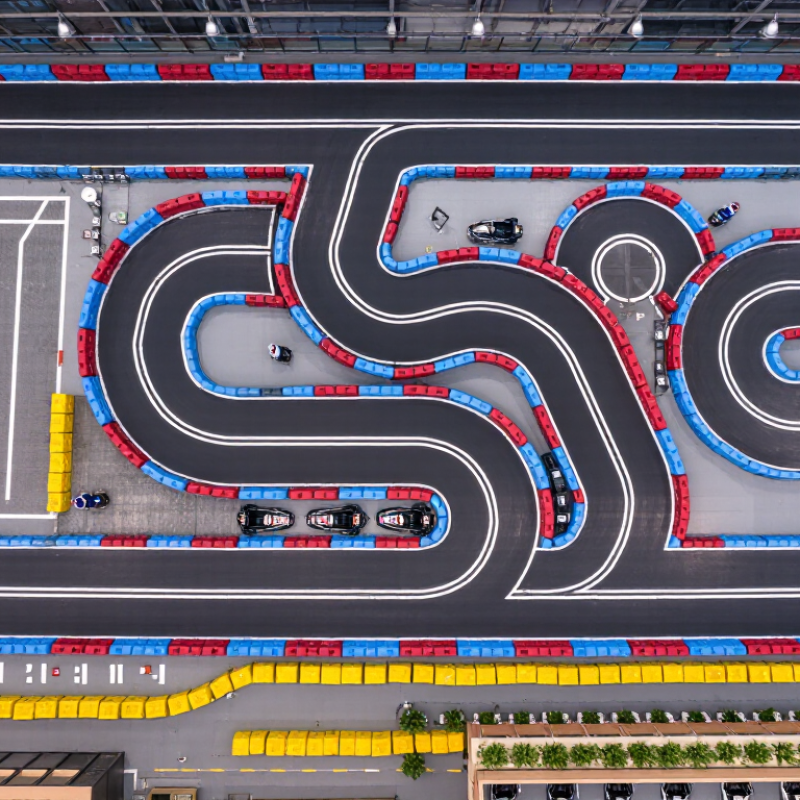
Designing a profitable karting venue in 2026 requires more than placing barriers around a concrete loop. Single‑Level Go‑Kart Track Design must connect safety, traffic flow, operator visibility, and customer excitement. Grand View Research reports continued growth in the global go-karting market, driven by indoor entertainment, family recreation, and competitive racing. IAAPA’s 2024 Global Attractions Outlook also highlights experience-led venues as strong investment opportunities. These findings support careful track planning, not oversized promises.
Alan Wilson, an internationally recognized circuit designer, has often emphasized a practical principle: “A good circuit creates challenge without compromising safety.” That idea matters on a single-level layout. A marshal should see the hairpin from the control point. Drivers should approach a chicane with clear sightlines. A 7-meter pit-lane buffer, non-slip flooring, impact-absorbing barriers, and controlled entry gates can improve daily operation. Exact dimensions still depend on kart speed, venue size, local standards, and evacuation planning.
The best design is not always the longest. Sometimes, it is easier to supervise. A compact 450-meter circuit can deliver stronger repeat visits than a confusing 700-meter layout. This is where buyers must question attractive renderings. Are the braking zones too short? Can staff reach an incident quickly? Does the queue block the café entrance? ASTM F24 guidance and FIA Karting safety principles provide useful reference points, but they do not replace site-specific engineering. One assumption may fail. Careful testing matters. This 2026 guide examines practical Single‑Level Go‑Kart Track Design choices for global buyers seeking safer operation, efficient construction, and memorable driving experiences.
For global buyers, a single-level go-kart track should begin with measurable operating needs. An 800–1,500 metre layout supports varied session lengths without requiring ramps or elevated structures. A 6–10 metre track width gives drivers clearer sightlines and safer overtaking zones. The CIK-FIA Karting Circuit Regulations, 2024, stress controlled track geometry, runoff planning, and consistent visibility. These principles matter even for recreational facilities.
A practical 1,000-metre course might use two 6-metre technical corners, an 8-metre braking section, and a 10-metre main straight. Wider areas help marshals and reduce congestion near pit entry. The FIA Environmental Accreditation Programme also encourages efficient site planning, lower energy use, and reduced construction impact. Buyers should request turning-radius drawings, drainage calculations, barrier positions, and emergency access measurements. Numbers expose weak proposals quickly.
Experience shows that wider is not always better. Excess asphalt can increase construction cost and make slower karts feel dull. I once reviewed a concept with beautiful long straights, but the final corner created repeated queues. The layout looked impressive on paper. It operated poorly. Local climate, driver skill, kart speed, and expected hourly capacity must shape the final design. A 1,500-metre track may need more staff, cameras, and maintenance than planned. That oversight is easy to miss.
Designing a single-level kart track for 60–90 km/h requires measurable FIA Karting geometry, not attractive curves alone. The 2025 FIA Karting General Prescriptions indicate international circuits typically use 7–12 metre track widths, with circuit lengths commonly between 700 and 1,700 metres. These figures support overtaking while preserving clear driver sightlines.
A practical layout should combine medium-radius corners, one controlled straight, and braking zones with visible entry points. At 90 km/h, a kart travels 25 metres every second. Small design errors become serious quickly.
Runoff areas, impact barriers, drainage slopes, and marshal access must be planned together. A 10-metre racing width can help two karts run side by side, but excessive width may reduce racing pressure. That balance is easy to miss.
FIA Karting safety guidance also emphasizes predictable track edges and unobstructed observation. Designers should test each corner using vehicle-speed simulations, then verify results with real-world driving data. Digital models are useful, but they can hide uncomfortable assumptions.
A corner that looks safe on screen may feel blind at racing speed. The design should therefore include braking-distance checks, wet-surface reviews, and independent safety inspections before construction. Data matters. Driver experience still exposes the gaps.
2026 Best Single Level Go Kart Track Design for Global Buyers
Design 3–5 m Safety Run-Offs Under EN 13814 Risk Controls
A single-level kart track should make risk visible before a driver reaches danger. Design 3–5 m safety run-offs beside high-speed corners, braking zones, and exit lanes. EN 13814-1:2019 supports documented hazard identification, protective measures, and verification. However, it does not make 3–5 m a universal compliance distance. Speed, kart mass, surface grip, driver ability, and barrier angle still matter.
The U.S. Consumer Product Safety Commission estimated about 30,000 amusement-ride injuries between 2017 and 2021. That figure is not kart-specific, but it shows why predictable impact areas deserve serious engineering. Use energy-absorbing barriers, level drainage, and unobstructed sightlines. Keep runoff surfaces free from kerbs, posts, loose gravel, and maintenance equipment. A neat drawing is not proof of safety. Test the layout with braking studies and realistic overshoot paths.
Tips: Mark the full 3–5 m zone on the construction plan. Measure it from the likely impact line, not the painted racing edge. Check wet-surface braking separately. EN 13814-2:2019 also emphasizes operating controls, inspections, and staff procedures. Therefore, include marshal visibility, emergency access, and pedestrian separation in the same risk assessment. The target may need revision. That is acceptable. Safety design should respond to evidence, not pride.
| Design Dimension | Recommended Planning Value | Design Application | Risk-Control Objective | Verification Method |
|---|---|---|---|---|
| Safety run-off width | 3.0–5.0 m minimum planning range | Provide the widest run-off at high-speed corner exits, braking zones, and areas where a kart can leave the racing line at a shallow angle. | Increase available deceleration and redirection space before a kart reaches a rigid barrier or another track hazard. | Site-specific risk assessment Confirm against approach speed, impact angle, barrier layout, and local authority requirements. |
| High-speed corner run-off | Prefer 5.0 m or more where the approach speed and exit angle justify it | Use expanded paved or engineered graded areas outside fast bends and corner exits. Avoid narrowing the run-off near the likely vehicle trajectory. | Reduce the probability and severity of impacts caused by loss of control, understeer, oversteer, or wet-surface grip variation. | Review swept-path simulations, braking distance, and credible overshoot trajectories. |
| Low-speed corner run-off | Normally not less than 3.0 m where a rigid hazard is present | Maintain a continuous clear zone beyond the outside edge of hairpins and tight turns. Increase the width if the corner leads directly into a straight. | Provide recovery space for spins and reduce direct contact with walls, posts, fencing, or other fixed objects. | Check the complete swept envelope of the largest permitted kart and the possible spin radius. |
| Track width | Approximately 6.0–8.0 m for a single-level recreational circuit | Select the width according to kart size, operating direction, overtaking policy, corner geometry, and the number of simultaneous users. | Support predictable vehicle separation, controlled overtaking, marshal visibility, and emergency access. | Validate with vehicle swept-path analysis and operating scenarios for novice and experienced drivers. |
| One-way operating layout | Continuous one-way circulation | Use a clearly defined circuit direction with no opposing traffic, crossover, or uncontrolled merging point on the racing surface. | Reduce the likelihood of head-on collisions and simplify driver instructions, marshal intervention, and evacuation planning. | Review the circuit plan, entry and exit interfaces, pit-lane separation, and emergency procedures. |
| Track-edge separation | Keep hazards outside the calculated run-off envelope | Locate buildings, columns, equipment, drainage structures, lighting supports, and other rigid objects beyond the run-off or protect them with a suitable impact-attenuating system. | Prevent exposed fixed hazards from becoming the first point of impact after a kart leaves the track. | Complete a hazard register and physical inspection of every inside and outside track edge. |
| Barrier and impact protection | Use a tested, energy-absorbing system selected for kart mass and speed | Place barriers only after the run-off layout has been optimized. Provide continuous protection where a kart could reach a rigid structure or where barrier ends may create snagging hazards. | Manage collision energy, limit sharp projections, and reduce secondary impacts or vehicle entrapment. | Obtain supplier performance data, installation details, maintenance criteria, and independent engineering review. |
| Run-off surface | Stable, skid-resistant, and free-draining | Use a surface that permits controlled deceleration without loose aggregate, abrupt level changes, deep ponding, or a sudden grip transition at the track edge. | Reduce secondary loss of control caused by debris, standing water, potholes, or unpredictable friction changes. | Inspect surface condition, drainage performance, edge transitions, and wet-weather behavior. |
| Track-edge transition | Smooth, visible, and free from trip or snag points | Design kerbs, shoulders, drainage channels, and pavement joints so that a departing kart is not abruptly launched, destabilized, or trapped. | Limit rollover, sudden yaw, wheel damage, and loss of control during an excursion. | Verify levels and profiles by survey; inspect the edge with representative kart wheels and suspension clearances. |
| Drainage and crossfall | Positive drainage without hazardous cross-slope changes | Direct rainwater away from the racing line and run-off areas while avoiding concentrated flows across braking zones or corner exits. | Maintain predictable grip and prevent standing water, aquaplaning risk, and contaminated surfaces. | Check drainage calculations, falls, inlets, discharge points, and performance during heavy-rain testing. |
| Braking-zone planning | Locate the largest run-off at the end of the longest or fastest braking approach | Align the clear zone with the likely straight-line overshoot path rather than measuring only from the nominal track edge. | Allow a driver who brakes late or loses grip to decelerate without immediately reaching a barrier or pedestrian area. | Estimate stopping distance using the permitted kart speed, surface friction, slope, reaction time, and wet conditions. |
| Pedestrian and marshal separation | No uncontrolled pedestrian access to the run-off or track envelope | Separate pit lanes, viewing areas, service routes, marshal posts, and walkways from kart trajectories using controlled access and suitable protection. | Prevent vehicle–pedestrian collisions and maintain safe intervention routes during incidents. | Review access control, sightlines, gates, refuge points, marshal procedures, and emergency response routes. |
| Visibility and sight distance | Clear view of braking points, corner entries, exits, and hazards | Avoid blind merges, hidden barrier ends, visual obstructions, and sign placement that competes with critical driving information. | Give drivers sufficient time to react to slower karts, stopped vehicles, flags, surface changes, or track incidents. | Assess visibility from the driver eye position in representative karts and under day, night, and wet conditions. |
| Lighting and electrical safety | Uniform illumination with protected equipment outside impact zones | Position luminaires, cables, control boxes, and emergency equipment away from likely kart paths or provide engineered protection. | Maintain visibility while preventing electrical hazards and rigid-object impacts. | Measure illuminance and uniformity; inspect equipment protection, cable routing, and emergency isolation. |
| Emergency access | Direct, unobstructed access to every critical track sector | Provide suitable gates, service paths, recovery points, and clear routes for first-aid, fire response, recovery, and evacuation operations. | Reduce response time and prevent secondary exposure during a collision, fire, medical event, or vehicle breakdown. | Conduct timed access drills and verify turning radii, gate widths, load capacity, and communication coverage. |
| Operating-speed control | Set speed limits according to layout, kart performance, user group, and protection level | Use briefing, signage, electronic controls, marshal instructions, and operating rules to prevent speeds that exceed the assessed design envelope. | Keep kinetic energy and stopping requirements within the capacity of the track, run-offs, barriers, and operating team. | Document the design speed, monitor actual speeds, and review controls after incidents or layout changes. |
| Risk assessment and documentation | Documented hazard identification, risk reduction, validation, and residual risk | Apply the principles of EN 13814 risk control to the complete installation, including layout, barriers, equipment, operations, maintenance, and emergency arrangements. | Demonstrate that hazards have been identified, risks reduced as far as reasonably practicable, and protective measures verified. | Maintain design drawings, calculations, inspection records, operating procedures, training records, and change-control documents. |
| Commissioning and periodic inspection | Pre-opening inspection plus scheduled and event-triggered checks | Inspect run-off condition, barriers, kerbs, drainage, lighting, signs, gates, communication systems, and kart-track interfaces before operation. | Detect deterioration, displacement, contamination, or unauthorized modifications before they create a new hazard. | Use signed checklists, defect severity criteria, corrective-action records, and post-incident inspections. |

A successful single level go kart track begins with a measurable heat plan. For global buyers, 8–12 karts per heat offers a practical starting range. The final number depends on track length, kart speed, driver skill, and marshal visibility.
Record real lap times during testing. Suppose a 600-meter circuit produces an average lap time of 72 seconds. An eight-minute heat then allows about six laps, with time for the opening and closing sequence. Ten karts create a clear operating target. Each kart needs enough space to brake safely before corners, especially near hairpins and pit exits. More karts are not always better.
Flow rate also controls daily capacity. If the loading area releases one kart every eight seconds, the theoretical rate reaches 7.5 karts per minute. A complete cycle may include an eight-minute heat, three-minute unloading period, and four-minute loading period. That equals 15 minutes per cycle, or roughly 40 karts per hour with ten karts per heat. Actual results may be lower.
Measure again.
Use lap counters, queue records, and staff observations. Compare peak-hour demand with the pit lane’s holding capacity. A single level layout can feel crowded when beginners brake unexpectedly, even when calculations look acceptable. I would begin with eight karts, review incident-free flow, then increase gradually toward twelve. This approach is less impressive on paper, but more reliable during busy operation.
For 2026 single-level go-kart tracks, material selection should balance grip, drainage, repairs, and climate exposure. Asphalt usually offers predictable traction and simpler patching. Concrete provides higher compressive strength but can transmit harsher impacts. EN 16230-1 emphasizes track safety, surface condition, barriers, and operational inspection. Local engineers must still verify subgrade performance. Standards cannot replace site experience.
Timing systems deserve more than a colorful leaderboard. Compare transponder detection, backup recording, lap-count recovery, and synchronization during electrical interruptions. A practical specification should require documented accuracy and independent testing. Manual correction remains possible. That is uncomfortable, but realistic. FIA timing guidance supports reliable classification and controlled data handling, while operators should test crowded pit exits and overlapping signals before opening.
Drainage and energy loads often decide long-term operating costs. NOAA Atlas 14 provides location-based rainfall frequency data, so designers should size channels for local storm intensity, not global averages. Include crossfall, slot drains, sediment access, and emergency overflow routes. The IEA Electricity 2024 report forecasts average global electricity-demand growth of 3.4% through 2026. Use efficient lighting, ventilation controls, and load monitoring. The U.S. Department of Energy reports that LED lighting uses at least 75% less energy than incandescent lighting. Still, peak loads from chargers, pumps, timing servers, and safety systems need separate calculations. The first estimate is rarely perfect.
Planning comparison of typical annual electricity demand for key single-level kart track systems. The benchmark assumes 300 operating days per year, six operating hours per day, LED track lighting at 24 kW, timing equipment at 0.3 kW, ventilation at 8 kW, and drainage pumps at 2 kW operating for two hours per day.
A durable single-level layout normally uses a high-grip asphalt wearing surface, approximately 1–2% crossfall for surface water movement, and positive drainage near low points. LED lighting generally produces the largest operating load, while electronic timing systems require relatively little energy. Actual consumption will vary with track length, opening hours, climate, lighting levels, pump duty cycle, and local construction standards.