How to Choose the Best Bamboo Cooling Mats for Your Business
Choosing the right Bamboo Cooling Mats can shape customer satisfaction, return rates, and your brand’s reputation. For this guide, fictional bamboo-sourcing specialist Mei Lin offers a practical principle: “Judge the mat by its construction, care needs, and performance—not by the word bamboo alone.” This is an illustrative quote, not a verified statement from a real expert.
Start with the details your buyers will notice. Check the mat’s dimensions, surface finish, edge binding, and flexibility. Ask suppliers how the bamboo is processed, what the inner structure contains, and which cleaning methods they recommend. Request samples, then inspect them under ordinary store lighting. Feel the surface. Look for rough edges, uneven strips, or a finish that feels slick when damp. Small details matter.
Cooling comfort varies with room temperature, humidity, bedding, and personal preference, so avoid promising a specific result for every user. Compare sample consistency across batches, packaging durability, minimum order quantities, lead times, and available product documentation. A low unit price can look attractive, until damaged packaging or inconsistent sizing complicates fulfillment. Not every supplier will answer clearly; that deserves a second look. This outline helps business buyers weigh product quality, supplier reliability, customer fit, and long-term value. It also leaves room for honest limits: bamboo mats may feel cooler to some customers, but they are not a substitute for climate control.
Define Your Business’s Needs for Bamboo Cooling Mats
Before comparing bamboo cooling mats, define who will use them and where. A pet retailer may need scratch-resistant mats that wipe clean, while a hospitality buyer may prioritize uniform sizing, quiet placement, and easy storage. Measure the intended floor or bed area, then note humidity, ventilation, cleaning routines, and expected daily use. Small details matter. A mat that feels cool in a showroom may perform differently in a warm, still room. Ask suppliers how they test surface temperature and durability, and request results under conditions similar to yours.
Clarify the construction, too. “Bamboo mat” can mean slatted bamboo, woven bamboo, or a textile containing bamboo-derived fibers; these are not interchangeable. Textile Exchange’s Materials Market Report 2024 estimates that global fiber production reached 124 million tonnes in 2023. That figure is not a bamboo-mat demand forecast, but it underscores why buyers should check fiber composition and sourcing claims rather than rely on vague labels. Request material specifications, care instructions, and sample units for practical trials. A common planning mistake is ordering by appearance alone. I would test a small batch first, even when the finish looks convincing, and record comfort, cleaning time, and damage after repeated use.
Compare Bamboo Materials, Weaves, and Construction
For a business sourcing bamboo cooling mats, start by distinguishing solid bamboo slats from bamboo-derived fabric. Slat mats offer a firm, wipe-clean surface, while fabric versions feel softer and may suit bedding or travel products. The label “bamboo” alone does not explain how the material was processed. Ask suppliers for material specifications and sample pieces before comparing prices.
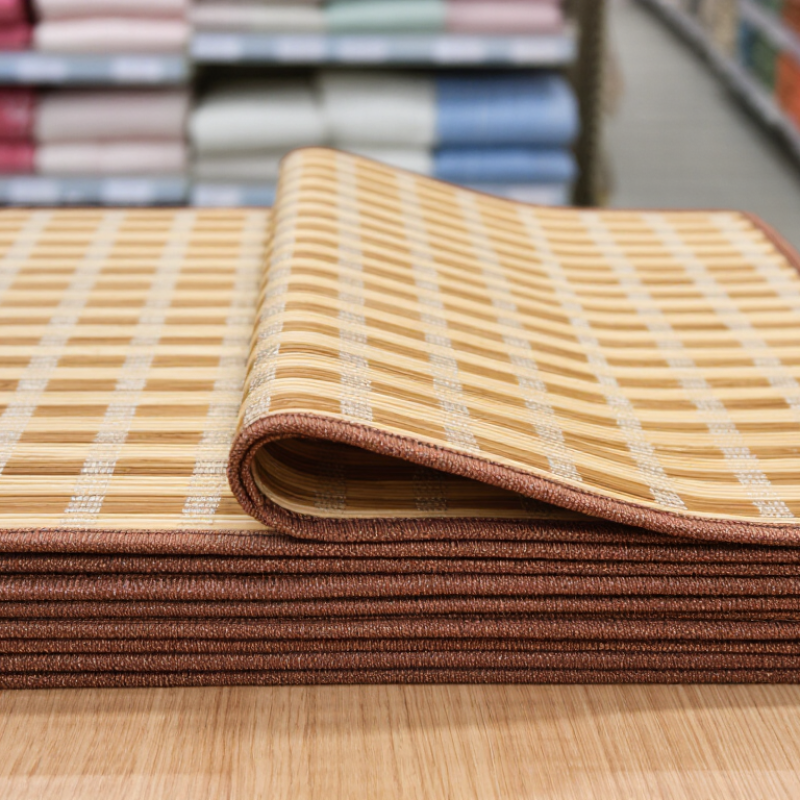
Weave affects feel, flexibility, and upkeep. Closely spaced, smooth slats create a more even surface and are less likely to catch on clothing. Wider gaps can improve airflow, but may feel uneven against bare skin. Check the joins, too. Cotton or synthetic thread can hold slats together, and loose stitching may fail after repeated rolling. Small details matter.
Construction quality is visible at the edges and joints. Look for consistent slat thickness, rounded corners, secure binding, and a finish without rough spots or strong odors. A coating may simplify cleaning, but it can also change the surface feel; ask what care instructions apply. Test samples by unrolling and rolling them several times, then inspect for shifting slats or frayed ties. One sample is not enough to judge every batch, so consider setting written inspection criteria. Even careful checks have limits. Natural materials can vary in color and grain, which may complicate a perfectly uniform product line.
Assess Cooling Performance, Comfort, and Available Sizes
Assess cooling with a repeatable test, not a “naturally cool” label alone. Place each mat in the same room, then compare surface warmth after 30 minutes of contact. Check airflow, moisture buildup, and whether the surface feels clammy. A smooth bamboo surface may feel cool at first, but room temperature and ventilation affect comfort. Textile Exchange’s Materials Market Report 2024 estimates global fiber production reached 124 million tonnes in 2023. This market figure is not proof that bamboo cools better; ask suppliers for material details and test results.
Comfort depends on use. For a pet or lounge area, check for smooth edges, stable slats, and a surface that does not shift under pressure. For bedding, assess flexibility and noise, too. A firm mat can feel refreshing, yet uncomfortable after a long period. I would test it myself before making a large order; a short showroom trial can miss overnight discomfort.
Tips: Compare small, medium, and large samples on the same surface. Measure the usable area, not just the outer frame. Record surface temperature and user feedback after 30 minutes. Offer sizes that fit common beds or floor spaces, plus one larger option. Don’t overpromise: cooling feel varies by room and person.
Check Durability, Safety Standards, and Cleaning Requirements
When comparing bamboo cooling mats, inspect the joints, edges, and surface finish—not just the product photos. Ask suppliers for durability results and the exact test method. ISO 13934-1:2013 measures tensile strength in textile fabrics; it can help assess a fabric cover, but it does not prove that bamboo slats or bindings will hold up. Request evidence from repeated-use or load testing for those parts. Small details matter. Look for loose stitching, sharp splinters, and gaps that could pinch fingers.
For safety, ask what dyes, coatings, adhesives, and fasteners touch the user. OEKO-TEX STANDARD 100 tests textile components for harmful substances, with requirements depending on product class. A certificate should match the actual item and components supplied. Check its validity rather than relying on a logo alone. That step is easy to overlook.
Cleaning needs can decide whether a mat suits your operation. ISO 6330:2021 sets domestic washing and drying procedures for textile testing, but many bamboo mats are designed for wiping, not machine washing. Request written care instructions, then test them on a sample: wipe the surface, dry it fully, and check for odor, lifting finish, or rough edges. I would not assume “easy-clean” means low maintenance; moisture trapped between slats can still be a problem.
Evaluate Suppliers, Bulk Pricing, and Warranty Terms
When evaluating bamboo cooling mat suppliers, request a physical sample before discussing a large order. Check that the slats lie flat, the connecting threads feel secure, and the edges have no rough splinters. Ask how the mats are dried and packed, since trapped moisture can affect storage and product quality. A neat product photo is not enough.
Get written bulk prices at several order quantities. Compare the unit price alongside packaging, freight, lead times, and any fees for custom sizing. Ask whether a quoted price remains valid if delivery is delayed. Small details matter. A lower unit cost may not be the better deal if cartons arrive damaged or restocking takes weeks. I would also verify that sample specifications match the production order; this step is easy to overlook.
Read warranty terms before paying a deposit. Confirm the coverage period, what counts as a defect, and how claims are documented. Ask who pays return shipping and whether replacements or credits are offered. Natural materials can vary slightly, so clarify which differences are considered normal. The wording may seem fussy, but vague terms create friction later. Keep the supplier’s answers and product specifications in writing, and review them again when the purchase order is prepared.