





Gym Equipment is more than metal frames, rubber plates, and glowing screens. It is a practical system for building strength, improving movement, and supporting consistent exercise. Buyers should understand what each machine does before comparing brands, prices, or impressive specifications.
Dr. Wayne Westcott, a respected strength-training researcher, says, “Strength training is not just about building muscle; it is about improving function.” That principle matters when choosing Gym Equipment. A beginner may need an adjustable bench, resistance bands, and light dumbbells. A home lifter may prefer a power rack, barbell, and protective flooring. A commercial gym requires heavier frames, service support, and equipment that withstands repeated daily use.
Details often decide whether a purchase succeeds. A treadmill needs suitable belt space, stable handrails, and enough motor capacity for its users. A cable machine should move smoothly, with secure pulleys and understandable weight markings. Storage also matters. A crowded room can make good equipment difficult to use.
Not every popular product fits every buyer. That is easy to forget. A large multi-station machine may look professional but consume valuable space. A cheaper bench may seem sensible, yet wobble during pressing movements. This guide examines equipment types, user needs, safety considerations, and purchasing trade-offs. It cannot remove every uncertainty. However, it can help buyers make calmer decisions based on goals, available space, budget, and real training habits.
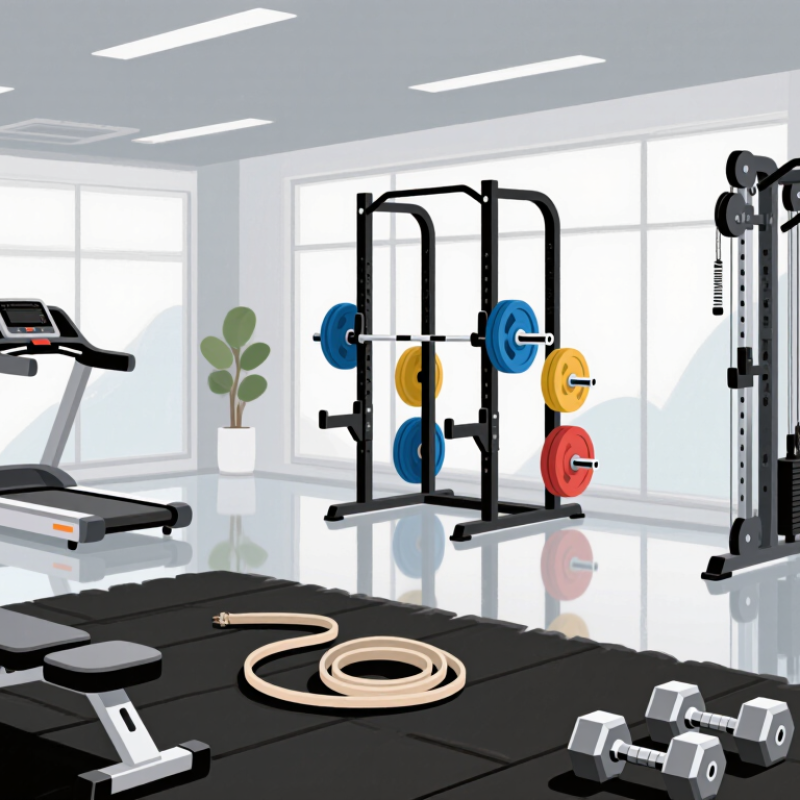
Gym equipment covers more than treadmills and weight machines. It includes cardio, strength, mobility, and functional tools. Each category serves a different training purpose.
Cardio equipment includes treadmills, bikes, rowers, and step machines. These tools support aerobic capacity and controlled calorie expenditure. Strength equipment ranges from dumbbells and barbells to cable stations and resistance bands. It helps users build force, muscle, and bone-loading capacity. Mobility tools include mats, foam rollers, stretching straps, and massage balls. Functional equipment, such as kettlebells, medicine balls, suspension trainers, and agility ladders, supports movements like lifting, rotating, and carrying. The 2024 Global State of the Health & Fitness Industry Report from the Global Health & Fitness Association valued the global fitness market at about 96.7 billion dollars in 2023. That scale suggests broad demand, but it does not mean every household needs a commercial setup. Not every buyer needs a full rack.
Tips: Match equipment to measurable goals, available floor space, and training experience. Beginners may need adjustable weights, a stable mat, and one cardio option. Experienced users might add a power rack or cable system. Check load ratings, adjustment points, and maintenance access before buying. The American College of Sports Medicine’s 2024 Worldwide Survey of Fitness Trends placed functional fitness among the leading trends. Still, trends can encourage unnecessary purchases. A kettlebell may be useful, but only if the buyer can control it safely. My practical mistake was treating variety as progress; consistent use usually matters more. A professional assessment can expose movement limitations that product descriptions cannot.
Gym equipment generally falls into four groups: cardio machines, strength equipment, mobility tools, and functional-training tools. The chart compares representative activities by approximate metabolic equivalent (MET), a standard measure of exercise intensity.
Approximate MET values are based on representative activities listed in the Compendium of Physical Activities. Actual intensity varies with speed, resistance, technique, fitness level, and workout duration.
What Is Gym Equipment and Which Types Do Buyers Need?
The World Health Organization recommends at least 150 minutes of moderate activity weekly. It also advises muscle-strengthening exercises on two or more days. This target changes how buyers should choose gym equipment. A treadmill, exercise bike, or rowing machine can support moderate cardio in manageable sessions. Adjustable dumbbells, resistance bands, and a stable bench can cover basic strength training. You do not need a crowded room.
Think about your weekly routine before purchasing. A person working from home may prefer a quiet bike for 30-minute sessions. Someone with limited space might choose resistance bands and adjustable weights. Beginners often need equipment that feels simple and safe, not highly technical. I have found that unused equipment quickly becomes expensive storage. Motivation matters more than impressive specifications. Still, the 150-minute target can feel demanding during busy weeks. Missing one session does not ruin the plan, but it deserves honest reflection.
Tips: Divide activity into five 30-minute sessions. Keep frequently used equipment visible. Choose adjustable items when storage is limited. Check weight limits, floor stability, and maintenance needs before buying. Add strength sessions gradually, especially after a long inactive period. A basic training log can show whether the equipment supports real progress. Do not buy every option.
| WHO Activity Reference | Equipment Category | Typical Activities Supported | Best-Fit Buyer | Practical Buying Considerations | Space and Use Profile |
|---|---|---|---|---|---|
| At least 150 minutes of moderate-intensity aerobic activity per week | Treadmill or walking machine | Brisk walking, incline walking, light jogging | Home users who prefer predictable, weather-independent cardio | Check running or walking surface size, maximum user weight, speed range, handrail stability, emergency-stop function, noise, and maintenance access. | Large footprint; suitable for regular sessions of 20–40 minutes. |
| At least 150 minutes of moderate-intensity aerobic activity per week | Stationary bicycle | Steady cycling, interval cycling, low-impact cardio | Beginners, apartment users, and people seeking reduced impact on joints | Prioritize adjustable seat height, stable pedals with straps, resistance levels, comfortable posture, and a frame that fits the user’s inseam. | Moderate footprint; usually easier to place than a treadmill. |
| At least 150 minutes of moderate-intensity aerobic activity per week | Elliptical trainer | Continuous aerobic exercise using coordinated upper- and lower-body movement | Users wanting a low-impact full-body cardio option | Evaluate stride length, step-up height, moving-handle stability, resistance range, maximum user weight, and smoothness of motion. | Large and relatively tall; requires clear space around moving handles and pedals. |
| At least 75 minutes of vigorous-intensity aerobic activity per week may provide similar health benefits | Indoor rowing machine | Power intervals, steady rowing, full-body conditioning | Experienced users who want high-effort sessions in limited workout time | Check rail length, footplate adjustability, seat travel, resistance mechanism, storage capability, and user technique requirements. | Long footprint; folding or vertical-storage designs can reduce storage demand. |
| Muscle-strengthening activities involving all major muscle groups on 2 or more days per week | Adjustable dumbbells or fixed-weight dumbbells | Presses, rows, squats, lunges, carries, and accessory exercises | Most home users, especially those needing versatile equipment | Choose secure handles, durable weight markings, manageable increments, balanced construction, and storage that prevents tripping hazards. | Small footprint; supports many exercises without a large machine. |
| Muscle-strengthening activities involving all major muscle groups on 2 or more days per week | Resistance bands and tube systems | Upper-body, lower-body, core, mobility, and rehabilitation-oriented resistance work | Travelers, beginners, budget-conscious buyers, and small-space households | Look for clearly differentiated resistance levels, reinforced connection points, comfortable grips, door-anchor safety, and inspection guidance. | Very small footprint; easy to store and transport. |
| Muscle-strengthening activities involving all major muscle groups on 2 or more days per week | Adjustable bench and compact rack | Pressing, rowing, step-ups, split squats, and supported dumbbell exercises | Strength-focused users with a dedicated workout area | Verify weight capacity, locking mechanisms, frame stability, adjustment angles, floor protection, and clearance for the intended movements. | Moderate-to-large footprint; requires a level floor and safe movement clearance. |
| Older adults should include multicomponent physical activity emphasizing functional balance on 3 or more days per week | Balance and functional-training equipment | Supported balance drills, sit-to-stand practice, stepping, and controlled stability work | Older adults and users returning to activity, with professional guidance when needed | Select non-slip surfaces, stable support points, low step height, rounded edges, and equipment appropriate to the user’s balance ability. | Small-to-moderate footprint; keep the surrounding area unobstructed. |
| Activity can be accumulated through shorter bouts; any movement is generally preferable to prolonged inactivity | Exercise mat and mobility accessories | Stretching, floor-based strength work, warm-ups, cool-downs, and mobility exercises | All buyer groups, particularly beginners and home users | Check mat thickness, grip, cleanability, length, cushioning, and whether accessories can be stored safely. | Minimal footprint; supports short activity sessions throughout the day. |
Reference framework: World Health Organization, Guidelines on Physical Activity and Sedentary Behaviour (2020). Equipment supports physical activity but does not replace appropriate progression, safe technique, or medical advice when required.
Gym equipment includes machines and tools that support strength, mobility, and cardiovascular training. Cardio machines deserve careful selection because their value depends on a buyer’s goal, available space, and training intensity. A treadmill suits walkers, runners, and interval users, while an exercise bike offers seated training with less impact on the joints. Rowing machines train the legs, back, and arms together. They also demand consistent technique.
Start with the training goal. Choose a treadmill for regular walking or running, an upright bike for compact daily sessions, or a rowing machine for full-body conditioning. Measure the room before buying. Leave space around moving parts, and check ceiling height for elevated platforms. A folding frame can save floor space, but it may feel less stable during hard intervals. Storage is useful, not magical.
Intensity changes the requirements. Light users may value quiet operation, simple controls, and easy access. Frequent runners need a stable deck, reliable speed changes, and durable moving parts. Test the machine for ten minutes if possible. Listen for rattling. Notice awkward posture. I once focused too much on maximum speed and overlooked poor handle placement. That mistake showed why comfort matters during ordinary sessions. Buyers should also review the warranty, maintenance access, user-weight rating, and emergency stop features. If pain, dizziness, or unusual fatigue appears, professional medical advice is more appropriate than a harder workout.
Strength equipment includes free weights, resistance machines, cable systems, racks, benches, and bodyweight stations. For buyers, the useful question is not “Which tool is strongest?” It is “Which tool fits the user, load, and exercise?” A beginner may benefit from a stable machine with clear adjustments. An experienced lifter may need a rack, adjustable bench, and suitable barbell loads. A narrow room also changes the decision.
Match the equipment to the movement pattern. A squat rack supports squats, presses, and pulling exercises when enough space and safety arms are available. Dumbbells allow unilateral work, but heavier pairs demand secure storage and controlled handling.
Cable systems suit rows, presses, rotations, and gradual resistance changes. Machines can guide movement, although fixed paths may not suit every body shape. Seat height, handle position, and range of motion deserve careful testing.
Load capacity must match both current ability and realistic progress. Check the frame, fasteners, adjustment pins, bench stability, and stated weight limits before use. Keep floors clear, use collars where appropriate, and avoid lifting beyond controlled form.
I once chose a compact bench that fit perfectly, but its limited adjustment reduced exercise options. That mistake reminded me to test movement, not just dimensions. A qualified coach or physical professional can help assess technique, injury history, and suitable progression. Equipment decisions become safer when user needs guide the purchase.
ACSM’s 2024 fitness trends place wearable technology at the center of modern exercise. This trend changes how buyers judge gym equipment. A treadmill is no longer only a moving belt. It may need heart-rate tracking, workout records, and clear progress feedback.
Smart equipment should solve a real training problem. For example, a rowing machine can display stroke rate, distance, and effort levels. A stationary bike can adjust resistance during interval training. These features support measurable goals without making every session complicated. They also connect with mobile exercise habits, another important direction identified by ACSM.
A buyer should match technology with the user. Older adults may value balance support, simple controls, and safe resistance changes. People managing weight may prefer equipment that records steady activity and encourages regular use. Worksite wellness programs may need compact machines, shared profiles, and easy cleaning.
In a small home gym, a smart display can become distracting. Some readings may also be inaccurate when sensors fit poorly or users skip setup. That weakness deserves attention. Buyers should check data privacy, maintenance needs, screen visibility, and offline functions before purchasing.
Strength equipment, adjustable weights, and functional training tools still matter. Smart features should improve movement quality, not replace professional guidance. The best choice may be a basic machine with dependable feedback, rather than an expensive system with unused functions.
