
















Cooling demand is rising, and evaporator selection now affects energy use, reliability, and operating cost. The International Energy Agency’s The Future of Cooling report projects that global space-cooling energy demand could more than triple by 2050. That pressure makes the Water Chiller Evaporator a critical design decision, not a minor component choice.
This guide compares flooded, falling-film, direct-expansion, shell-and-tube, and brazed-plate evaporators. Each design transfers heat differently. A flooded shell-and-tube unit may suit large chilled-water plants with stable loads. A brazed-plate model can reduce footprint in compact commercial systems. Falling-film technology may improve refrigerant distribution, but installation quality remains essential. Direct-expansion evaporators can respond quickly, although refrigerant control becomes more sensitive.
Real conditions matter.
ASHRAE Handbook guidance emphasizes load behavior, fluid temperatures, fouling, pressure drop, and maintenance access. AHRI Standard 550/590 provides recognized methods for rating water-chilling packages, including full-load and part-load performance. These references help engineers compare equipment under consistent conditions. However, catalog efficiency is not the whole story. A unit operating at 40% load, with mineral deposits on its tubes, may perform very differently from its laboratory rating.
A practical selection should examine leaving-water temperature, entering-water temperature, annual load profile, refrigerant compatibility, approach temperature, pump energy, and cleaning requirements. Site water quality deserves attention too. One overlooked detail can become an expensive service call.
There is no universal “best” evaporator. The right choice balances efficiency, footprint, redundancy, budget, and the skills available for maintenance. This article offers a structured way to make that decision with clearer evidence and fewer assumptions.
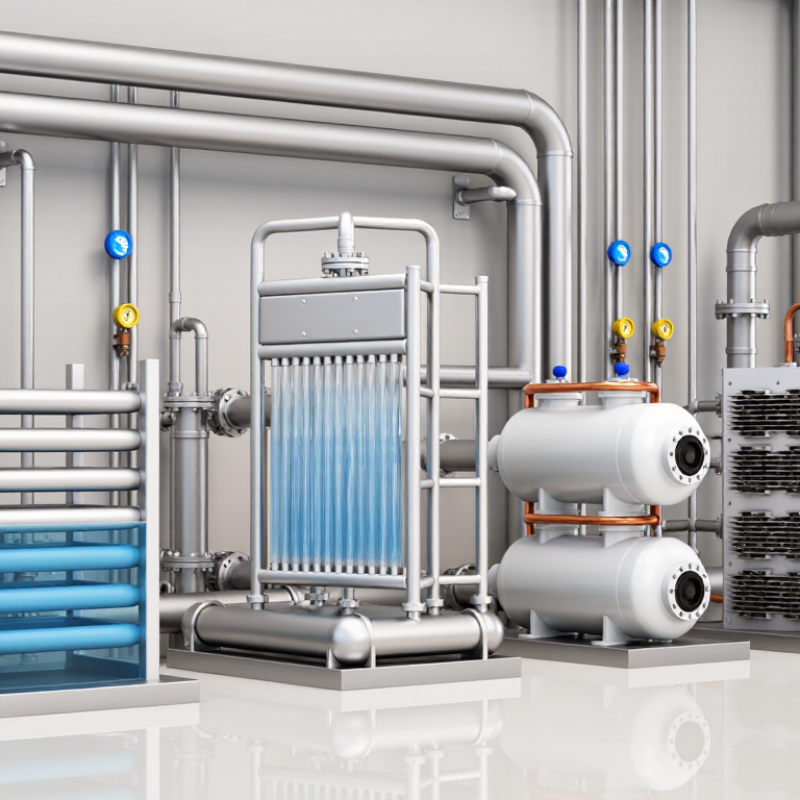
Top Water Chiller Evaporator Types: How to Choose?
A water chiller evaporator transfers heat from process water into a refrigerant. This exchange creates the cooling effect used in buildings, factories, and equipment rooms. Shell-and-tube evaporators are durable and tolerate larger water flows. Brazed plate evaporators are compact and offer efficient heat transfer. Flooded designs can perform well under steady, heavy cooling loads, but they require careful refrigerant control.
The evaporator’s role extends beyond simple heat removal. Its design affects flow resistance, freezing risk, cleaning needs, and long-term operating stability. When choosing one, check cooling capacity, entering and leaving water temperatures, pressure drop, water quality, and available space. Hard water may encourage scaling inside passages. Small passages can then lose performance quickly. I have seen designs look efficient on paper but struggle when maintenance access is ignored. That detail deserves more attention.
Tips: Match the evaporator to real operating conditions, not only rated capacity. Keep water flow within the manufacturer’s recommended range. Install temperature sensors near the inlet and outlet. Use strainers where debris may enter the circuit. Inspect for fouling before efficiency drops noticeably. Plate units suit limited spaces, while shell-and-tube units may offer easier mechanical cleaning. No choice is perfect. Seasonal loads, imperfect water treatment, and future expansion can change the best option.
A water chiller evaporator transfers heat from chilled water to refrigerant. Its design affects efficiency, maintenance, and freeze protection.
The flooded shell-and-tube evaporator places refrigerant around tubes carrying water. Refrigerant boils outside the tubes and absorbs heat evenly. This design offers strong thermal performance, but it needs careful oil return and refrigerant control.
A direct-expansion evaporator sends refrigerant through tubes while water flows around them. Refrigerant evaporates inside the tubes as it removes heat from the water. It usually needs less refrigerant than a flooded design. However, uneven flow can create temperature differences and local freezing.
Falling-film evaporators spray refrigerant over horizontal tubes. A thin liquid film forms, boils, and removes heat from water inside the tubes. They can reduce refrigerant charge, but spray distribution must remain consistent.
Compact plate evaporators use alternating channels for refrigerant and water. Their counterflow arrangement creates a small temperature approach and saves installation space. Brazed plates suit compact systems, while gasketed plates allow easier cleaning.
Field inspections often reveal clogged strainers, poor water treatment, or incorrect flow rates. These details can reduce performance more than the evaporator type itself.
Selection should match load variation, water quality, available space, and service skills. The most efficient option on paper may be difficult to maintain in a real plant. That part deserves honest review.
Top Water Chiller Evaporator Types: How to Choose?
Comparing evaporators starts with the cooling duty, not the equipment label. Shell-and-tube evaporators often tolerate variable water quality and provide steady operation. Brazed plate evaporators are compact, lightweight, and usually transfer heat efficiently. However, their narrow passages may respond poorly to fouling or suspended particles. Flooded designs can offer strong heat transfer, while direct-expansion systems may reduce refrigerant charge in suitable applications.
Performance should be measured under identical conditions. Check cooling capacity, leaving-water temperature, refrigerant pressure drop, water pressure drop, and approach temperature. A smaller approach temperature usually indicates better heat transfer. It may also require a larger heat exchanger or cleaner water. Do not compare catalog values from different flow rates. That mistake creates attractive but unreliable conclusions.
Field experience adds another layer. Inspect tube cleanliness, control stability, oil return, and frost or scaling patterns during operation. A plate unit may perform impressively for months, then lose efficiency quickly without proper filtration. A shell-and-tube unit may consume more space but remain easier to service. Energy use matters too, including pump power and compressor lift caused by pressure losses. One assumption deserves challenge: maximum efficiency is not always the best choice. Maintenance access, water chemistry, load variation, and technician skill can change the result. Real operating data should challenge the first design decision.
| Evaporator Type | Typical Refrigerant Arrangement | Typical Water-Side Pressure Drop | Heat-Transfer Performance | Part-Load Efficiency | Fouling and Maintenance | Freeze and Leakage Considerations | Best-Fit Applications |
|---|---|---|---|---|---|---|---|
| Flooded Shell-and-Tube | Refrigerant surrounds the tubes; chilled water flows inside the tubes. | Approximately 30–80 kPa at design flow, depending on tube arrangement and flow rate. | Excellent Large refrigerant-side surface area and effective boiling provide strong thermal performance. | Excellent Generally maintains efficient refrigerant distribution at reduced load. | Tube brushing or mechanical cleaning is practical; requires oil-management and refrigerant-level control. | Tube leaks can allow refrigerant and water cross-contamination; low-flow and freeze protection are essential. | Large central water chillers, industrial cooling, and systems requiring high efficiency and serviceability. |
| Dry-Expansion Shell-and-Tube | Refrigerant expands inside tubes; chilled water flows over the outside of the tubes. | Approximately 30–80 kPa at design flow, subject to shell-side design and water velocity. | Good Reliable performance with a relatively simple refrigerant circuit. | Good Performance depends on expansion-valve control and maintaining adequate superheat. | Tube-side or shell-side cleaning is possible; water quality still strongly affects long-term capacity. | Water-side freezing can damage tubes; refrigerant distribution and oil return must be properly controlled. | Medium-to-large chillers where robust construction, straightforward operation, and cleanability are priorities. |
| Brazed-Plate Heat Exchanger | Refrigerant and chilled water pass through alternating corrugated plates separated by brazed joints. | Approximately 30–100 kPa, but higher pressure drop is common when compact sizing is prioritized. | Excellent High turbulence and close plate spacing enable high heat-transfer coefficients. | Good Compact refrigerant passages can perform efficiently, but control must prevent unstable flow. | Cannot normally be opened for mechanical cleaning; requires clean water, filtration, and chemical flushing when suitable. | Higher sensitivity Small passages increase blockage and freeze risk; leakage may require complete replacement. | Compact packaged chillers, small commercial systems, heat pumps, and applications with limited installation space. |
| Gasketed-Plate Heat Exchanger | Refrigerant and water flow through alternating channels formed by gasketed plates. | Approximately 40–120 kPa, depending on plate count, channel design, and selected approach temperature. | Excellent High surface-area density and close temperature approach are possible. | Good Effective at variable load when flow control and refrigerant distribution are correctly designed. | Easy to open and clean Gaskets require inspection and periodic replacement; plate tightening must follow the manufacturer’s procedure. | Gasket aging can cause external or internal leakage; freeze protection is still required on the water side. | Systems requiring compactness, inspectability, adjustable capacity, or frequent water-side cleaning. |
| Falling-Film Shell-and-Tube | Refrigerant is distributed over the outside of tubes and evaporates as a thin falling film; water flows inside tubes. | Approximately 30–80 kPa at design flow, depending on tube configuration. | Excellent Low refrigerant charge and efficient evaporation can support high seasonal efficiency. | Excellent Often suitable for efficient operation over a broad load range when distribution remains uniform. | Tube cleaning is practical, but refrigerant distributor maintenance and oil-return control are important. | Low refrigerant inventory can reduce some system risks, but inadequate wetting or low water flow may increase freeze risk. | Large high-efficiency chillers where reduced refrigerant charge and strong part-load performance are important. |
Notes: Values are typical engineering ranges for water-cooled evaporators and vary with refrigerant, chilled-water temperature, flow rate, approach temperature, tube or plate geometry, fouling allowance, and operating conditions. Final selection should be based on certified manufacturer performance data, allowable pressure drop, water quality, freeze protection, service access, and lifecycle cost.
Selecting a water chiller evaporator requires matching its design to the application, not choosing the highest advertised efficiency. Flooded shell-and-tube evaporators suit large comfort-cooling systems with steady loads. They provide strong heat transfer and stable leaving-water temperatures. However, they need reliable oil management and usually contain more refrigerant. Direct-expansion evaporators are compact and respond quickly, making them practical for smaller systems or fluctuating process loads. Falling-film designs can reduce refrigerant charge, but poor distribution or low-load operation may affect performance.
For clean water loops, brazed-plate evaporators offer a small footprint and efficient heat transfer. They can be sensitive to fouling, freezing, and water-quality changes. Process cooling needs closer attention. Food production, plastics, and data facilities may require redundancy, precise temperature control, or continuous operation. AHRI Standard 550/590 provides a recognized framework for chiller performance testing, while the ASHRAE Handbook—HVAC Systems and Equipment discusses evaporator selection and fouling considerations. The International Energy Agency reports that global space-cooling energy demand could more than triple by 2050, increasing pressure for efficient, maintainable designs.
Tips: Check design flow, entering-water temperature, fouling risk, minimum load, and service access. Do not size only for peak capacity. A larger evaporator may improve efficiency, yet it can increase cost and control difficulty. This is often overlooked. Site water quality should influence the final decision, even when the equipment schedule appears complete.
Top Water Chiller Evaporator Types: How to Choose?
Evaporator selection starts with water quality, load variation, and service access. Shell-and-tube evaporators suit larger systems and tolerate changing loads when properly controlled. Plate evaporators are compact, but narrow passages demand excellent filtration and chemical balance. According to the IEA report The Future of Cooling, global cooling electricity demand could more than triple by 2050 without stronger efficiency measures. Installation details matter.
Leave clear space around inspection covers and removable tube bundles. Install thermometers and pressure gauges on both water circuits. Confirm flow direction before commissioning. A small piping mistake can create unstable temperatures, air pockets, or freezing risk. Insulation must remain dry, especially near flanges and drain points. These details are often rushed.
Maintenance should follow operating hours, water conditions, and manufacturer limits, not a convenient calendar. ASHRAE Standard 180 emphasizes documented inspection and maintenance for commercial HVAC systems. Record approach temperature, pressure drop, flow rate, and refrigerant conditions. Rising pressure drop may indicate fouling before capacity visibly declines. Tube cleaning requires the correct brush or chemical method; aggressive cleaning can damage surfaces. Plate units need careful gasket inspection and tightening patterns.
Service planning should include spare gaskets, sensors, and isolation valves. Keep service records near the equipment. It saves time. A useful admission: even a strong checklist can miss biological growth or poorly calibrated instruments. Independent testing under AHRI 550/590 procedures can verify chiller performance, but field conditions still differ from laboratory ratings. Regular trend review remains essential.
Shell-and-tube evaporators are generally preferred where durability, refrigerant containment, and mechanical tube cleaning are important. Brazed plate evaporators offer compact installation and efficient heat transfer, but they are more sensitive to water quality and usually cannot be mechanically cleaned. Gasketed plate evaporators provide easier service access, while flooded shell-and-tube designs require careful oil-return and refrigerant-charge management.
