


An Animatronic Western Dragon can give a park more than a striking photo opportunity. It can become a living landmark, visible above a stone gate or framed by a canyon-themed ride. Slow turns, a lifted head, and a measured wing movement can make guests pause. The effect depends on restraint. Too many motions may feel noisy; too few can leave the creature looking like a static sculpture.
For transparency, the expert below is fictional, and the quotation is an original editorial line—not a verified statement from a real industry professional. In this draft, animatronic design consultant Mara Ellison offers a useful principle: “A dragon feels believable when every movement serves its story.” That idea guides the questions park teams should ask: Does the creature fit the setting? Can guests see its details from different paths? Will its movements remain engaging after repeated visits?
The strongest design begins with practical choices. Consider the dragon’s scale, viewing distance, lighting, sound, and daily operating needs. A bronze-colored muzzle may catch the afternoon sun; carefully timed eye movement can draw attention without overwhelming nearby scenes. Not every effect needs to be dramatic. Sometimes a quiet breath-like motion works better. The concept also deserves honest review: a spectacular first impression does not guarantee a memorable experience. With thoughtful design and dependable upkeep, an Animatronic Western Dragon can support a park’s story while giving guests a reason to look twice.
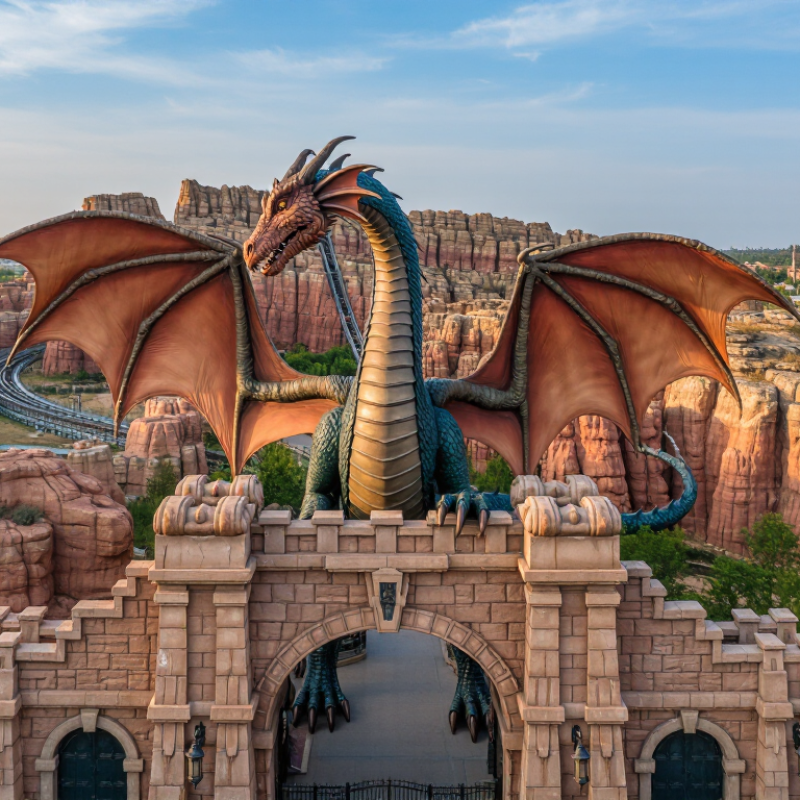
A Western dragon works best as a character with a purpose, not simply a large moving figure. Guests might hear a low rumble, see one amber eye open, then watch its wings lift above a rocky nest. These details establish a story before anyone reads a sign. The dragon could guard a mountain pass, protect a lost egg, or respond when visitors approach. Keep the scene focused. Too many effects can muddy the story.
The TEA/AECOM 2023 Theme Index reported 244.6 million visits across the world’s 25 most-attended theme parks, up 23.5 percent from 2022. Attendance alone does not prove that storytelling drives visits. Still, it shows the scale of competition for guest attention. A clear character and repeatable scene can give families a reason to pause, watch, and return. Small gestures matter. A turning head can feel more believable than constant motion.
For park teams, define the dragon’s role before specifying its mechanics. Decide what it notices, how it reacts, and when it rests. Then match movement, sound, lighting, and viewing distance to that behavior. Test sightlines with children and adults; a dramatic pose may disappear behind a railing. There is a trade-off: more motion can increase impact, but it also adds maintenance demands. The story should survive even when one effect is unavailable.
TEA’s 244.6 million visits across the 25 most-attended parks in 2023 show the scale of the theme park audience. They do not represent 244.6 million potential dragon guests. Visits are not unique people, and attendance at those parks cannot predict demand at one attraction. Still, the figure offers useful context: even a small share of a large audience can justify testing a distinctive experience.
For an animatronic Western dragon, estimate demand at the attraction level. Count how many guests pass its location, then observe how many stop, take photos, or join a nearby activity. A dragon’s moving head, textured scales, and low rumble may draw attention, but sightlines and show timing matter too. Small details matter. Compare results across busy and quiet days, and track queue length and dwell time. A dramatic effect can attract a crowd, yet crowding may block paths or shorten viewing time.
Treat any early estimate as provisional. Guest surveys can reveal whether the dragon feels memorable or merely loud; observation can show what guests actually do. That gap is worth noticing. A short pilot, using timed performances and simple visitor counts, can help refine capacity and staffing assumptions before a larger investment. The national visit figure is a benchmark, not a forecast. A park’s own traffic patterns should carry more weight.
Why Choose an Animatronic Western Dragon for Your Park?
An outdoor dragon must handle weather as well as delight guests. Choose motions that read clearly from a pathway: a slow head turn, a visible blink, and a measured wing lift. Keep the movement envelope clear of railings and nearby trees. For exposed sites, specify corrosion-resistant fasteners, sealed cable connections, and replaceable, UV-stable surface coatings. ASTM G154 provides a method for exposing nonmetallic materials to fluorescent UV light; ask suppliers for test details, not just “weatherproof” claims. Small distinction, big difference.
Weather planning matters. NOAA recorded 28 U.S. weather and climate disasters costing at least $1 billion each in 2023, with combined losses of about $92.9 billion. That figure is not a park-specific risk estimate, but it underscores why wind, rain, heat, and drainage belong in the design brief. Use site climate records to set operating limits. Choose effects accordingly: low-voltage lighting and controlled mist can create atmosphere, while exposed fog nozzles may clog or drift in wind. Test sound levels and visibility during daylight, too.
Tips: Ask for a written wind and temperature operating range. Inspect seams, drains, and cable entries after rain. Keep one detail under review: a dramatic wing span may look impressive, yet complicate maintenance access.
| Design area | Common choice | Outdoor considerations | Advantages | Planning note |
|---|---|---|---|---|
| Head and neck motion | Slow turns, nods, and jaw movement | Allow for wind exposure, safe movement limits, and access to moving joints. | Creates a clear character focal point with comparatively simple movement. | Use controlled, repeatable motion and keep moving parts away from visitor reach. |
| Wings and tail | Fixed wings or limited, low-speed movement | Large surfaces catch wind; moving parts need suitable support and clearance. | Adds scale and silhouette without requiring every body section to move. | For exposed sites, a static pose or restricted movement may be easier to manage. |
| Skin and surface finish | Outdoor-suitable sculpted skin with a compatible protective coating | Sunlight, rain, temperature changes, and cleaning can affect finishes and flexible surfaces. | Supports detailed scales, texture, and a distinctive Western dragon appearance. | Confirm UV, moisture, and cleaning compatibility with the material supplier; inspect regularly. |
| Frame and anchoring | Engineered internal support fixed to a suitable foundation | Wind loads, soil or slab conditions, drainage, and local building requirements matter. | Helps keep the figure stable and provides support for its moving components. | Have anchoring and structural loads reviewed for the actual site and installation. |
| Sound and lighting | Directional audio and low-voltage LED lighting | Outdoor electrical equipment, connections, and enclosures need protection appropriate to their exposure. | Improves visibility and atmosphere, especially during evening operation. | Specify suitable ingress protection for the installation and follow electrical codes. |
| Fog or water effects | Optional theatrical fog or a designed water feature | Wind can disperse fog; water requires drainage and careful separation from electrical systems. | Adds a dramatic reveal or “breath” effect when conditions and operation allow. | Check local safety rules, slip risks, ventilation, and any restrictions on theatrical fog. |
| Service and weather planning | Accessible service panels and a documented inspection routine | Seasonal weather, dust, debris, and water exposure influence inspection needs. | Makes routine checks and repairs more practical over the installation’s service life. | Plan for safe access, cleaning, drainage checks, and the maker’s maintenance instructions. |
A Western dragon can turn a quiet queue into a vivid scene: articulated wings, glowing eyes, and a measured burst of sound. But spectacle should follow a documented safety process. ASTM F24 standards address amusement ride and device design, operation, maintenance, and quality assurance. For a dragon integrated with a moving ride, engineers can review applicable requirements such as ASTM F2291 for design and ASTM F770 for operations. Applicability depends on the attraction’s actual configuration; a stationary figure may raise different questions from a ride-mounted effect. Standards are not a substitute for review by qualified engineers or the relevant authorities.
Treat the dragon as part of the whole attraction. Document its motion envelope, pinch points, access panels, emergency stops, inspection intervals, and safe states after power loss. Test movements under realistic conditions, including heat, vibration, and repeated operating cycles. Small details matter. A wing tip that clears a railing during a workshop test may not clear it after installation.
The TEA/AECOM 2022 Theme Index reported 198.7 million visits across the world’s 25 most-visited theme parks, up from 141 million in 2021. That attendance figure signals the scale of guest-flow planning, not demand at any single park.
Build procedures around actual capacity, staff training, and maintenance records, then review them as conditions change. One detail may still be missed. Keep the review open.
Why Choose an Animatronic Western Dragon for Your Park?
A dragon display can draw visitors in, but its service plan matters long after opening day. Map access panels, cable routes, and lifting points before the scenic shell is built. A technician should reach motors and controls without dismantling rocks or fencing. Keep spare joints and sensors dry, labeled, and close to the work area. Small details save time.
Budget beyond the purchase price. The U.S. Department of Energy’s Operations and Maintenance Best Practices Guide notes that operations and maintenance can represent 60–80% of a facility’s life-cycle cost. That is a building benchmark, not a reliable forecast for one animatronic dragon. Use it as a warning to model labor, inspections, parts, power, and planned refurbishment separately. The estimate will still be imperfect.
Accessibility belongs in the layout, not as a late adjustment. CDC’s 2023 report found that 28.7% of U.S. adults reported a disability, based on 2022 data. Provide a step-free viewing route, turning space, and clear sightlines for seated guests. Consider sound levels and a quieter viewing point, too. Test the route with visitors; drawings can miss awkward turns. Revisit costs yearly, because wear rarely follows a neat schedule.
Estimated annualized costs for three display sizes, showing maintenance, accessibility provisions, and major-component replacement reserves.
Planning model: Illustrative USD estimates, not industry averages or vendor quotes. Assumptions use a 10-year planning period, annual maintenance at 8% of installed cost ($30,000, $90,000, and $200,000), and accessibility and major-component allowances spread evenly across that period. Actual costs vary with design, climate, usage, and site requirements.
