





Why Choose Commercial Playground Swing Sets?
Choosing commercial playground swing sets is not simply a purchase decision. It shapes how children move, socialize, and test their confidence in a shared outdoor space. A well-designed swing can turn a quiet corner into a lively gathering point, with children gripping textured chains, adjusting their balance, and waiting for their turn.
Dr. Joe L. Frost, a respected playground researcher, observed, “Play is the business of childhood.” His insight explains why commercial equipment should support more than basic movement. Strong swing frames, age-appropriate seats, smooth hardware, and impact-absorbing surfacing can create a safer and more comfortable play experience. These details matter when equipment serves schools, parks, childcare centers, and busy community spaces every day.
Durability is another practical reason to choose commercial playground swing sets. They are built for repeated use, changing weather, and regular maintenance routines. Operators can inspect connection points, chains, seats, anchors, and surrounding clearance more easily when the design follows recognized safety guidance. Still, no swing set solves every planning problem. That assumption deserves challenge. Poor supervision, unsuitable surfacing, or weak site planning can reduce the value of excellent equipment.
The best choice combines children’s enjoyment with responsible management. It considers traffic flow, accessibility, installation quality, maintenance records, and the real age range of users. A swing may look simple. Its design decisions are not. When these factors work together, commercial swing sets become a dependable investment in active, inclusive, and memorable play.
What Defines a Commercial Playground Swing Set?
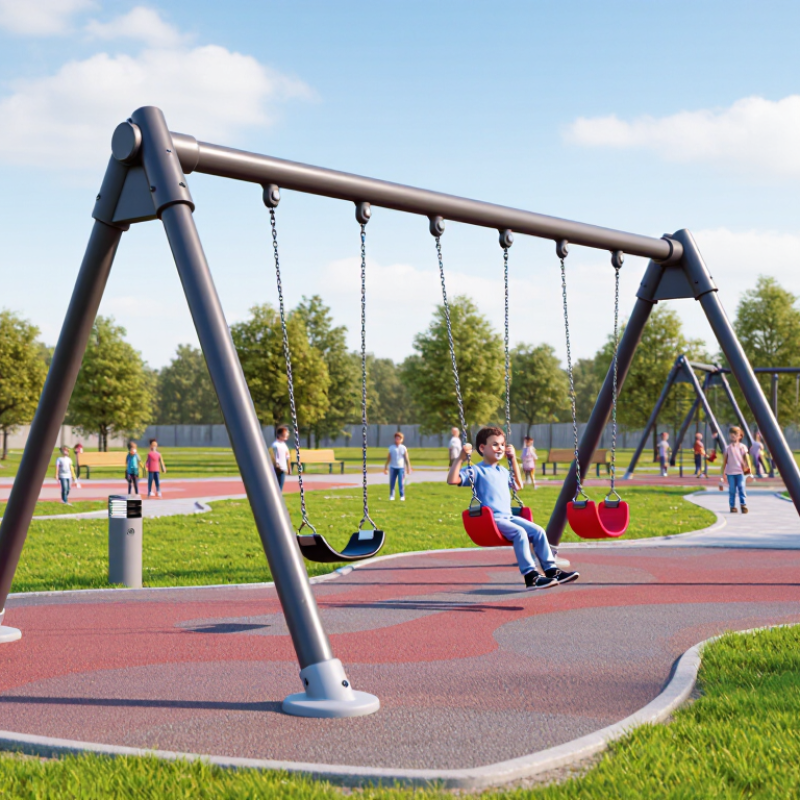
A commercial playground swing set is more than a taller backyard model. It is a public-use structure engineered for frequent, demanding play. Its frame usually uses heavy-gauge steel, durable coatings, and carefully finished joints. Seats need secure chains, smooth edges, and strong connections. The design also considers spacing, fall zones, accessibility, and supervision. In practical site inspections, small details matter. A loose fastener or shallow surfacing area can change daily safety conditions. That reality helps define commercial equipment.
Commercial equipment must withstand weather, repeated movement, and varied users. Reliable suppliers should provide load guidance, installation instructions, and maintenance information. Operators also need routine checks for rust, cracks, worn chain links, and displaced surfacing. Compliance with applicable playground standards is essential, but standards alone do not replace judgment. A well-designed set can still perform poorly on uneven ground. Attractive layouts may also reduce visibility for caregivers. Function matters more than appearance.
Tips: Measure the complete use zone before ordering. Include swing travel, impact-absorbing surfacing, and clear access routes. Choose seats for the intended age range and users. Ask for inspection records and replacement-part guidance. Keep a written maintenance log. It sounds excessive. It is not. Recheck high-wear points after storms, busy weekends, and seasonal temperature changes. No design eliminates every risk, so thoughtful supervision still matters.
Why Choose Commercial Playground Swing Sets? - What Defines a Commercial Playground Swing Set?
| Data Dimension | Commercial Playground Swing Set | Typical Residential Swing Set | Why It Matters in a Public Playground |
|---|---|---|---|
| Primary Use |
Frequent public use Designed for parks, schools, childcare centers, housing communities, and other shared environments. |
Intended mainly for private household use by a small, familiar group of children. | Public equipment must tolerate higher traffic, more varied users, and less predictable usage patterns. |
| Structural Materials | Commonly manufactured with galvanized or powder-coated steel, heavy-duty aluminum, or engineered structural components. | Often uses lighter-duty steel, timber, plastic, or mixed materials selected for lower-frequency use. | Corrosion-resistant and robust materials help improve service life and reduce maintenance in outdoor conditions. |
| Swing Beam Design | Typically uses reinforced beams, welded or mechanically secured joints, and engineered connections intended for repeated loading. | Usually uses a lighter frame with fewer swing positions and simpler connections. | A stronger beam and connection system helps manage repeated movement, dynamic loads, and daily impact. |
| Typical Swing Capacity | Frequently configured with two to six or more swing positions, depending on the site plan and equipment design. | Commonly configured with one to four swing positions. | More positions can increase user capacity and reduce waiting time when the playground serves multiple age groups. |
| Seat Options | May include belt seats, flat seats, toddler seats with high backs, and inclusive seats with specialized support. | Often includes basic belt seats, flat seats, or a toddler seat depending on the product configuration. | Different seat types allow the same playground to support toddlers, older children, and users with different physical needs. |
| Age Segmentation | Equipment is commonly specified for defined age groups, such as toddlers aged 6–23 months or children aged 2–12 years, subject to the applicable standard. | Age guidance is generally broader and is based on the manufacturer’s household-use instructions. | Clear age separation helps reduce collisions and ensures that seat design, swing height, and surrounding space are suitable for users. |
| Safety Standards | In the United States, commercial playground equipment is commonly designed and evaluated with references to ASTM F1487 and applicable U.S. Consumer Product Safety Commission guidance. Other regions may use standards such as EN 1176. | Household equipment is generally covered by residential-use requirements and manufacturer instructions rather than commercial playground standards. | Public-use standards address issues such as entrapment, impact zones, structural integrity, layout, and maintenance more extensively. |
| Fall-Impact Surfacing | Requires an appropriate protective surfacing system, such as engineered wood fiber, rubber surfacing, or other tested impact-attenuating materials. | May be installed over grass, soil, or household-use surfacing, depending on the product instructions and local requirements. | Proper surfacing reduces the severity of injuries from falls within the designated use and fall zones. |
| Use and Fall Zones | Needs planned clearance around the swing, including the front-to-back travel area and side separation from nearby equipment or obstacles. | Usually requires a smaller, simpler installation area defined by household instructions. | Adequate clearance helps prevent users from striking posts, fences, benches, or other playground components. |
| Anchoring | Commonly anchored to concrete footings or an engineered foundation according to soil conditions, installation requirements, and local regulations. | May use ground anchors, surface anchors, or smaller footings suitable for private installation. | Secure anchoring helps prevent shifting, tipping, uplift, and excessive movement during repeated use. |
| Weather Resistance | Often incorporates galvanized finishes, powder coatings, UV-resistant plastics, sealed components, and corrosion-resistant hardware. | Weather resistance varies widely and may be designed for less intensive exposure and use. | Outdoor public equipment must withstand rain, sunlight, temperature changes, humidity, and frequent cleaning. |
| Maintenance Requirements | Requires documented inspections, tightening of hardware, checking for wear, cleaning, surfacing maintenance, and prompt repair of damaged parts. | Maintenance is generally performed by the homeowner when problems are noticed. | A planned inspection program helps identify hazards before they affect a larger number of users. |
| Expected Service Conditions | Designed for repeated daily cycles, multiple users, and long-term outdoor installation when properly installed and maintained. | Designed for lower-frequency use and a smaller number of users. | Commercial-grade construction can provide better lifecycle value when replacement, downtime, and maintenance costs are considered. |
| Accessibility Potential | Can be integrated into an accessible playground layout with suitable transfer routes, accessible surfacing, and inclusive swing options. | Accessibility features are less commonly included and depend on the individual product. | Inclusive planning allows more children and caregivers to participate in the same recreational space. |
| Installation Documentation | Normally includes site planning information, assembly instructions, anchoring details, inspection guidance, and replacement-part information. | Usually includes basic assembly instructions and household-use warnings. | Detailed documentation supports consistent installation, inspection, staff training, and long-term asset management. |
Note: Dimensions, capacities, age ranges, and compliance requirements vary by design, jurisdiction, installation surface, and applicable safety standard. Always verify the product’s technical documentation and local regulations before installation.
Related Posts
-
Why Choose a Wooden Swing Set with Slide?
-
Discover the Best Playground Sets in China for Your Needs?
-
2026 Top Vinyl Playground Set Reviews and Buying Guide?
-
Top Playground Sets for Home That Kids Will Love?
-
2026 How to Choose the Perfect Polywood Swing Set for Your Backyard?
-
2026 Top Outdoor Playset Trends for Children and Families?